
Back to Blog
Psychology
How Much Does Online Therapy Cost in Bolivia? Understanding Psychologist Fees
Published:April 20, 2026
Updated:September 24, 2026
9 min read
Written by our practice team · Spanish original clinically reviewed by Junisse Montaño, MSc, Clinical Psychologist · College of Psychologists No. JMP-1004-25 · Last reviewed:
You're comparing prices before you decide, and it's a reasonable question: therapy is a recurring expense, not a one-time purchase.
At this practice, a 60-minute individual session costs 190 Bs and a couples session costs 300 Bs. The price is the same whether you come to the office in downtown Santa Cruz or the session is by video call. In the Bolivian market, private sessions usually range from 150 to 300 Bs for an individual session, so that's the range worth comparing against.
Below you'll find the full numbers, what explains the price differences between professionals, and the question almost nobody answers when you look up prices: how much the whole process ends up costing, not a single session.
How much does a psychology session cost in Santa Cruz?
These are the current fees as of September 2026:
| Session type | Length | Price |
|---|---|---|
| Individual session | 60 minutes | 190 Bs |
| Couples session | 60 minutes | 300 Bs |
| 4-session individual package | 60 minutes | 650 Bs (162.50 Bs per session) |
| 10-session individual package | 60 minutes | 1,500 Bs (150 Bs per session) |
The packages aren't a limited-time promotion: they exist because a process with continuity works better than scattered, one-off sessions. The four-session package saves you 110 Bs compared with paying for each session separately, and the ten-session package saves you 400 Bs.
If you're comparing psychologists in Santa Cruz by price, keep in mind that the per-session figure isn't always comparable: some sessions last 45 minutes and others 60, and that difference changes the hourly value quite a bit.
Does the price change for in-person versus online therapy?
No. A session costs the same at the office as it does by video call.
It's a question that comes up often, and the short answer tends to surprise people, because many assume online should be cheaper. That reasoning makes sense if you think about rent or travel costs, but that isn't where the real cost of a session lies: it lies in the professional's working hour, the preparation between sessions and the training behind it.
What does change with online sessions is your own associated spending. You save on the commute, parking and the dead time of getting there and back, which in Santa Cruz can take a good hour depending on the time of day. For many people, that's what makes the difference between sticking with the process and dropping it after a month.
In-person therapy takes place in downtown Santa Cruz de la Sierra, and online therapy covers the rest of Bolivia as well as Bolivians living abroad.
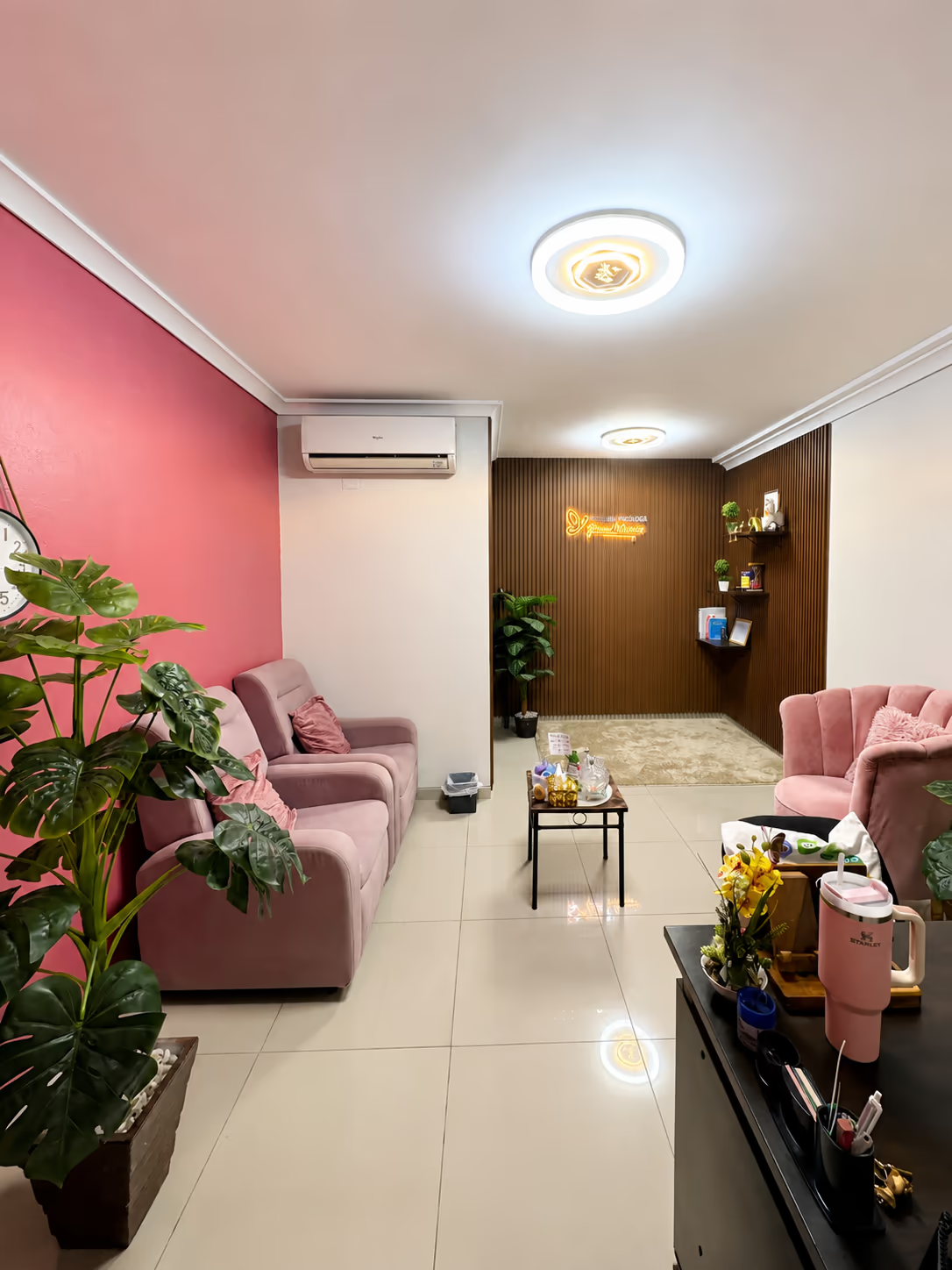
The practice's main room, in the Edificio Don Alcides in downtown Santa Cruz. Online sessions are held from this same space.
Why does one psychologist charge more than another?
Within that 150 to 300 Bs range, there are concrete factors behind each difference:
- Postgraduate training. A clinical specialization in a particular approach means years of additional study, and that's reflected in the fee.
- Years of clinical practice. It isn't seniority for its own sake: it's the number of cases similar to yours already worked through.
- Actual session length. Forty-five minutes and sixty minutes aren't the same, even if the published price looks similar.
- Clinical supervision. Professionals who take their cases to supervision pay for that space, and it's one of the things that best protects the quality of your treatment.
- Current professional registration. Being licensed and keeping your registration up to date comes with professional association fees.
There's one factor that shouldn't make a difference and sometimes does: how urgently you arrive. If a practice changes its price because you're in crisis, that isn't a difference in quality; it's something else.
What does the whole process cost, not just one session?
This is the question you're really asking, and almost no pricing page answers it.
Most cognitive behavioral therapy processes fall between 12 and 24 sessions. With weekly sessions, that's between three and six months. It's an approximate range, not a prognosis: how long it takes depends on the reason for seeking help and on each person, and it's discussed in the first session and reviewed along the way.
In money terms, combining the packages (one ten-session package plus two single sessions for 12 sessions; two ten-session packages and one four-session package for 24), a process of that size costs roughly between 1,900 and 3,650 Bs spread over several months. It's not a small number, but it's very different from the open-ended expense people imagine when they hear "therapy."
Two honest caveats. First: nobody can tell you in advance how many sessions you'll need, because it depends on what you bring, how long it's been going on and how much of the work you can keep up between sessions. Second: some conditions require longer processes, and some concerns are resolved in five meetings.
What can be done is to review it explicitly. In the first sessions a goal is defined, and every so often you look again at whether the process is heading there. Asking about this at the first appointment is completely legitimate.
What if 190 Bs per session is more than you can afford?
First of all, say so. It's a conversation that happens often and makes no one uncomfortable.
Packages are the most direct route. The ten-session package brings the cost per session down to 150 Bs, which is 40 Bs less than a single session. If the problem is the upfront payment rather than the price per session, it's worth asking about the available payment options before ruling out the process.
Spacing sessions out is better than not starting. A process with sessions every two weeks moves more slowly than a weekly one, but it moves. It's a clinical decision you talk through together, not something you have to figure out on your own.
There are also options outside private practice. Several universities with Psychology programs in Santa Cruz have clinics with reduced fees, where final-year students see clients under faculty supervision. Some public health centers and community organizations offer psychological care for free or at a low cost. We don't publish a list because openings, hours and requirements change often, and we don't want to send you knocking on a closed door: the most practical step is to call the university or the health center in your area directly and ask about their psychological care service.
Money being a real problem isn't a reason to go without care. It's a reason to say it out loud and look for a format you can actually sustain.
Is a very low price a red flag?
Not always, but it's worth looking at what's behind it.
A newly graduated professional charging less while building a practice is perfectly normal and can give you excellent care. So can a university clinic with low fees and faculty supervision.
What does deserve a closer look is a price far below the market with no explanation, especially if it comes with other things: you can't verify the professional registration, there's no clear address or format, results are promised in a fixed number of sessions, or diagnoses are offered by chat without an assessment.
Before choosing by price, check that whoever will treat you is licensed to practice. It takes a few minutes, and we explain it step by step in how to verify your psychologist is licensed in Bolivia.
How do you choose without price being the only factor?
Price is a reasonable filter, but it shouldn't be the final criterion. These questions help you compare two options that cost about the same:
- What approach do they work with? You don't need to understand the theory, but they should be able to explain in simple words what you'll be doing together and why.
- Do they have experience with what you're bringing? Anxiety, grief, couple conflict and children's behavior problems are each worked on differently.
- How long is the session, and how often? It changes the real cost and also the pace of the process.
- How do they handle cancellations? It's worth knowing beforehand, not when something unexpected comes up.
- Did you feel at ease in the first contact? The evidence on what makes therapy work places the therapeutic relationship very high, above the specific approach.
That last point isn't a soft detail. If after two or three sessions you still can't talk freely, say so. Changing professionals is a valid decision and not a failure of the process.
Frequently asked questions
How much does a psychology session cost in Bolivia? Private sessions generally range from 150 to 300 Bs for an individual session. At this practice, a 60-minute individual session costs 190 Bs and a couples session 300 Bs, at the same price in person or online. The full table of prices and services in Santa Cruz details what each format includes.
How much does couples therapy cost? A 60-minute couples session costs 300 Bs. How the work is done is explained in Couples Therapy in Santa Cruz, Bolivia.
What happens at the first appointment? It's a 60-minute initial assessment session, not a sales conversation. The first 50 minutes are spent listening to the reason you're seeking help, and in the last 10 an initial work plan is agreed on: how many sessions are estimated, how often, and what concrete goals. The fee that applies is the one you see when you book.
Is there a discount if I pay for several sessions together? Yes. Four individual sessions cost 650 Bs and ten cost 1,500 Bs, which lowers the cost per session to 162.50 Bs and 150 Bs respectively.
Does health insurance cover psychotherapy in Bolivia? Mental health coverage in private insurance in Bolivia is limited and varies a lot between policies. It's best to ask your insurer directly whether it covers outpatient psychological consultations and under what requirements.
How many sessions do I need? It depends on the reason for seeking help and on each person, so there's no exact answer in advance. As a reference, most cognitive behavioral therapy processes fall between 12 and 24 sessions, roughly three to six months with weekly sessions. It's an approximate range, not a prognosis: the plan is discussed in the first session and reviewed along the way.
Can I do online therapy from another city in Bolivia? Yes. Video call sessions cover the whole country: we see people from La Paz, Cochabamba, Sucre, Tarija and other cities without them having to travel, at the same price as an in-person session, and also Bolivians who live abroad. What a video call session is like, what you need and how to pay are explained in online therapy in Bolivia.
I live outside Bolivia. Does the price change, and how do I pay? The price is the same and is charged in bolivianos. If you no longer have a Bolivian bank account, the most convenient options are RIA and Western Union, which usually offer a good exchange rate; international bank transfer, PayPal or card are also available. The details, along with the time difference by country, are in Therapy for Bolivians Abroad.
Getting started
The price of a session matters, but the useful question is whether you can sustain a process for a few months. That's why it's worth looking at the cost of the full treatment and the payment options, not just the single number.
You can see how the work is done and what each format includes in Individual Therapy in Santa Cruz, Bolivia, or book a first session in person in downtown Santa Cruz or by video call from anywhere in Bolivia. If you're not in Santa Cruz, online therapy in Bolivia explains what a video call session is like and how to pay from any city.
Sessions are held in Spanish. Therapy in English is available with psychologist Jazmín Villazón.
Recommended local resources
If you'd like to work on this with professional support, you can move forward with local or online care.
Does this sound familiar?
If this article resonated with you, remember that you don't have to navigate your emotions alone. I'm here to support you through the process.
Book an Appointment on WhatsAppYou might also like
Psychological therapy
How to know if your psychologist is licensed in Bolivia (and why there's nowhere to check online)
In Bolivia there is no public registry where you can check whether a psychologist is licensed: neither the Ministry of Health and Sports nor the professional colleges offer a search tool, and they don't answer inquiries from third parties. This guide explains the documents that do prove a psychologist is authorized to practice (College of Psychologists membership or the professional license from the Ministry of Health and Sports), how to ask for them and how to read them.
Jul 22, 2026Read article
Psychological therapy
How do I know if I need to see a psychologist? 10 clear signs
Not sure whether you should see a psychologist? 10 clear signs that it's time to seek professional help, how to tell everyday distress from distress that needs treatment, and what to do about it in Santa Cruz de la Sierra.
Apr 21, 2025Read article
Anxiety
Anxiety: what it is, its symptoms and how to treat it with professional help
Anxiety and stress can intensify in uncertain times. Discover practical psychological strategies to regain calm and strengthen your emotional well-being.
Apr 21, 2025Read article